20/02/26 - 01:30
I've noticed an increasing trend of people claiming that things online (particularly videos) are AI generated with incorrect evidence (or no evidence at all). From real videos, to practical VFX, to CGI, anything they don't like the vibe of is 'just AI sadly'.
I think this is about as harmful as being tricked by AI slop. It discredits the creator, and over-estimates the capabilities of generative AI, which serves to hype up that industry.
A creator puts effort and passion into making something cool, be it writing, art, filming a video, animating something, making music. They post it online. A comment claims "It's AI, you can tell because of the way it does this thing I don't like". Other viewers see this comment, some agree, some know it's wrong but can't articulate why. Those who believe it, think the artist is a lazy hack, filling their feed with slop, killing the environment, whatever gripe they have with AI. And they think AI is capable of creating this thing, that it must have advanced in leaps and bounds while they weren't paying attention, and anything they don't like the look of could also be AI.
All around, not great.
In fairness, AI-generated video is getting scarily good. I've played around a bit with LLMs and image generators, so I have a good idea of what they can and can't do, and I'm usually pretty quick to tell if something has that 'AI smell' to it. But video generation is something I haven't kept as close an eye on, and it has improved a lot in just a few short months.
I thought it would be interesting to analyse some content which momentarily decieved me, and explore why it was convincing, and what gave it away.
First up, I was checking out some videos from CES 2026, particularly stuff about robotics, and stumbled across this video of a woman riding a robotic horse.
This nearly fooled me for a few seconds. The movement and physics seem realistic enough, the sound isn't implausible, and I totally missed the watermark. The video is only 9 seconds long, and so for about 15 seconds I was staring at it in confusion, thinking "That can't be real, but I don't know why". I think the biggest factor is the low resolution and short length. The low res hides the small inconsistencies and shimmering details that AI is bad at, and because it's so short, by the time it finished, I still hadn't decided whether it looked real. It was just plausible enough to fool me at a glance. I can imagine a lot of people scrolled right past this without giving it further thought, and now believe the robot depicted is real.
To be clear, I couldn't find any real robotic horses. Kawasaki has a concept for one, but it's still in the concept stage, and in the 1960's General Electric made a 'walking truck', but only the one prototype. Robotic locomotion is already a hard engineering problem without adding in the safety requirements of a human passenger!
So, what are the tells that this is AI generated? Aside from the watermark, it's in the small details. The womans leg dissapears several times as the angle changes, the cars outside are very weird, and the crowd falls solidly into the uncanny valley if you focus on them rather than the main subject (which I didn't do on first watch).
Another video was more mundane and came even closer to tricking me. If I hadn't stopped to re-watch and check the comments, I may very well have scrolled past it and believed it was real.
This one is much more plausible, just depicting a student hiding a cat on their lap in a classroom. It's higher res, with many cues to suggest it was filmed on a smartphone, from the camera movement to the wide angle lens. The cat looks shockingly good to me. The fur, whiskers, eyes, teeth they all look plausibly correct, without shimmering or morphing details when it turns its head or meows. When the POV subject covers its face, it reacts realistically, tensing and ears going back, and the physics between cat and hand look solid. The sounds all seem realistic enough, possibly the voices are off but as I don't know the language I can't catch any weird intonation. All in all, one of the best/most consistent AI-generated videos I've seen yet.
But, you guessed it, the devil is in the details. The biggest tell is the student in front of the POV subject. When the camera pans back up, they have moved forward one seat, and their clothes change. Additionally some of the faces, particularly the teacher, look uncanny, grinning emptily. A lot of the inconsistencies are masked by the camera movement and short duration, with most of the video being about the cat.
This is a common theme I've noticed with AI generated video - it can do one central subject pretty well, but everything around it, particularly smaller details in the background, falls apart the longer video goes on. But as these videos are short, usually on some vertical video platform, it's all too easy to miss that and scroll past. Low resolution and cropped/blurred out watermarks can help mask the most obvious tells.
Unfortunately, as AI-generated content progresses from 'obviously fake' to needing to be double-checked, a lot of people are growing more suspicious and skeptical of everything they see. After being fooled a few times, they get increasingly paranoid and start to fall victim to false negatives, suspecting AI when the culprit is something else. It could be VFX or CGI, a weird camera angle/lighting/optical illusion, or just something very impressive like a natural phenomenon or stunt, that they don't have a good baseline expectation of as reference. Lacking the terminology and analysis skills to be sure, they'll point out some weird detail as 'evidence' of AI, backed up by their dislike of AI in combination of their dislike of whatever they're seeing. As I explained in the opening paragraphs, I think this is bad. By all means call out AI slop, but you should be able to provide good evidence that it's AI slop, as I have tried to do with the previous examples, rather than just 'it looks wrong/weird'.
I saw this happen today on a reddit post about the video game PANLINE. PANLINE is a first-person parkour video game being made by a solo indie dev. It's very heavily inspired by Mirror's Edge Catalyst, to the point that I worry EA will kill it in the cradle due to copyright concerns.
So far there's not too much promotional material. One gameplay video, and some screenshots. And already, people are claiming these are AI-generated. Here's a few comments:
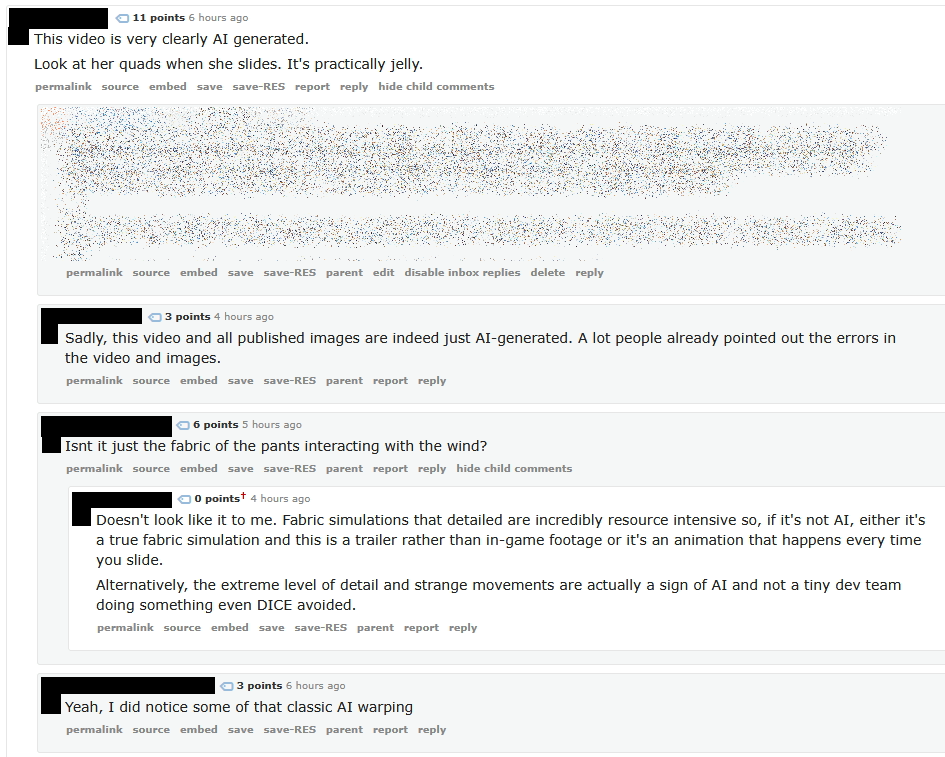
And some more...
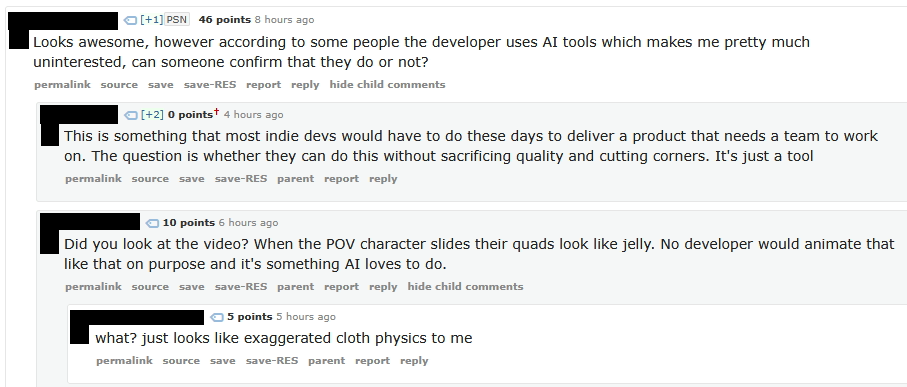
So, a mix of baseless skepticism, attempts to point out evidence/tells, and minimal, hesitant pushback. It reminds me of flat earthers in a way. Confused explanations, an attitude of "I don't understand therefore it must be fake".
One commentor points to the player characters legs being like 'jelly' in the sliding animation. They insist it must be AI because cloth physics simulations are expensive, so difficult to do that even a big studio like EA couldn't pull it off.
The ironic thing is, they dismiss the correct answer. It's just part of the sliding animation. Cloth physics sims are commonplace in video games (capes, scarves, etc). Going frame-by-frame, there are a few things that make it look weird ('like jelly'), but I see no signs of AI. The left leg clips through the floor, and the 'cloth physics' seem very exagerated, perhaps a keyframed animation or a visual effect rather than a true cloth sim, as the pattern on the right leg distorts quite a lot. But it's consistent across different frames, not showing the tell-tale sign of an AI forgetting details when they go out of sight.
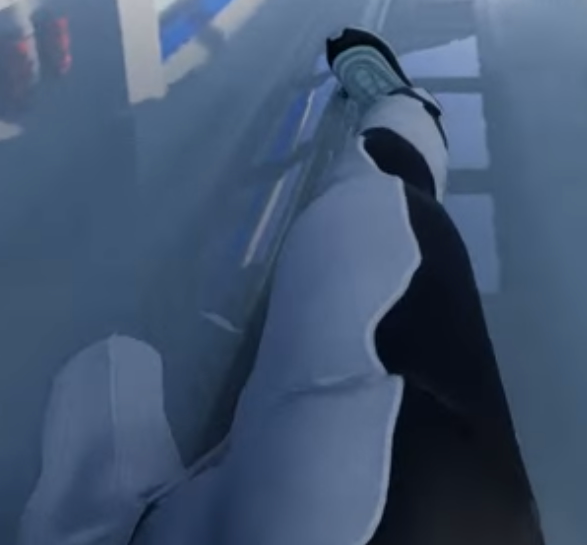
Left leg clips through the floor
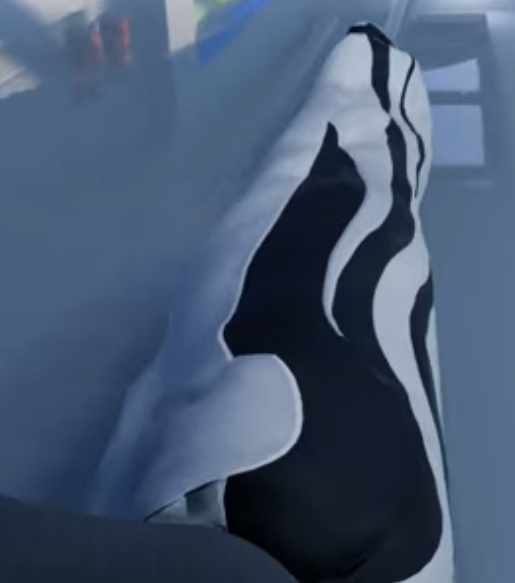
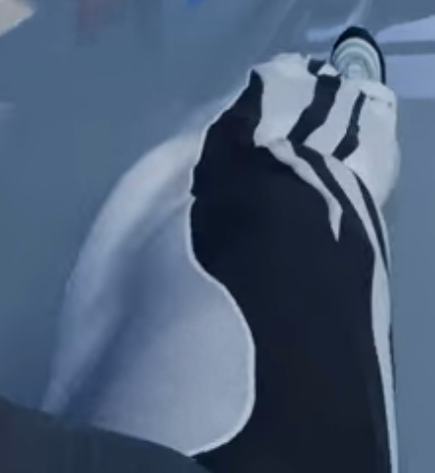
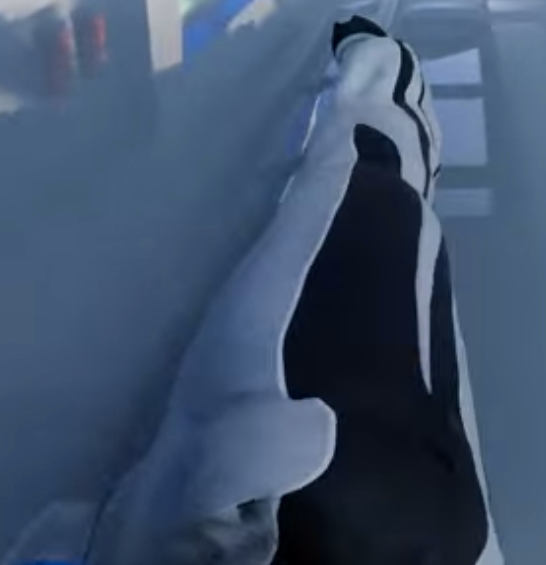
These close-ups show the leg distorting, but the complex pattern remains consistent.
Going back a few seconds earlier in the video, when the character kicks open a door, the same pattern is present on the leg. The shoe and glove are consistent too. The fine details are not morphing and shifting as one would expect from AI.

As discussed earlier, AI is pretty good at getting the central subject right, but tends to fail on background details. How do those fair in these clips? Well enough I feel confident it's not AI. Let's look at this sign, flag and and antenna visible in one of the trailers:



Perfectly consistent throughout. You can check any detail and find the same thing. Straight lines remain straight, crowded high-detail areas like overlapping fences don't shimmer and fizz beyond what you'd expect from a vidoe game, and things go out of frame and come back in later exactly the same.
Finally, there's consistency between different videos and images. One that stood out to me is a re-used tree asset. It's distinct and recognisable, complex, and once again, exactly the same every time it's seen. AI generations are inherently random, and this is clearly not.




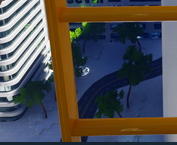

AI bros can only dream of this level of consistency.
There are plenty of other assets and details you can compare for yourself.
Although I feel confident asserting that these promotional materials are not AI-generated, that doesn't mean PANLINE isn't using any AI at all (for example, for textures, 3D models, writing/brainstorming, music, etc). There's not yet enough material to begin assessing that. But given the level of polish and quality I'm seeing, I'm very hopeful. The writing doesn't sound like an LLM, and while the worldbuilding and gameplay are clearly derivative of Mirror's Edge, they're also fresh and unique. It just seems too high-effort to be the work of somebody who tolerates AI slop. I hope I'm right, and I really look forward to the games release.